
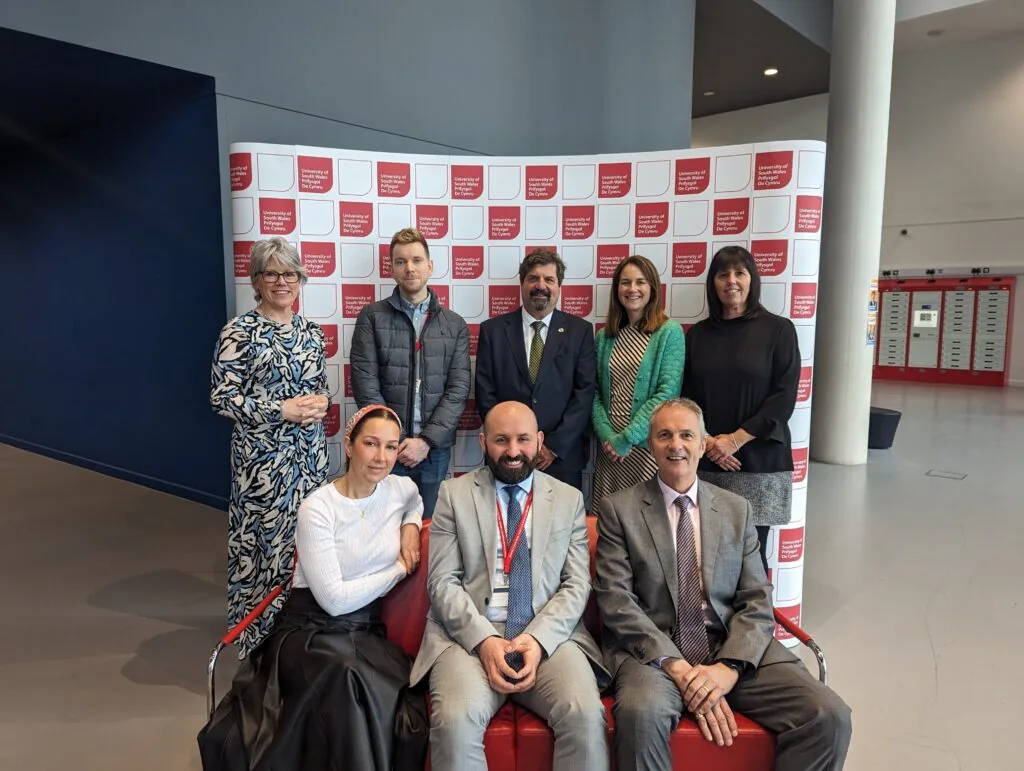
Launch of the centre — 12 March 2024
The following account describes the centre's launch in 2024.
On 12 March 2024, we were proud to launch the Hydra Research and Innovation Centre, in partnership with the University of South Wales at an event at Newport campus.
Sitting within the Faculty of Life Sciences and Education, the centre is led by Claire Parmenter, Director of Professional Practice and former Deputy Chief Constable, working closely with Dr Jonathan Crego, Visiting Professor and Director of the Hydra Foundation, and collaborating with colleagues from across USW.
The ethos behind Hydra is solving real world issues through collaboration. The Hydra suite environment enables participants to work in small groups to experience simulated problems that they may experience in their work-lives. There are two suites in our Glyntaff campus but the research centre will be based in Newport as part of the ongoing development work at the campus.
The Hydra Foundation is the gold standard for critical incident training and debriefing. While it was invented to facilitate ‘blue light’ training, it has potential to be used across all disciplines. The research centre will seek to use data, generated from Hydra exercises, to inform research projects that can improve organisational culture and decision making.
USW is one of almost 100 suites internationally using the Hydra methodology, but this research centre is the first of its kind. Dr Crego has chosen USW to be the hub of Hydra and to carry on the legacy of his foundation.
The event was opened by Dr Martin Steggall, Pro Vice Chancellor for Research and was attended by USW colleagues, representatives from partner organisations and colleges, and Newport City Council Leader, Jane Mudd.
Claire Parmenter said: “One of our first tasks was to develop a ‘culture and conduct’ scenario that will be shared across the UK emergency services to try and tackle the significant cultural challenges facing policing and the other emergency services. Whilst we cannot change people’s values, by putting them through this simulation we can give people the courage to stand up and call out damaging behaviours.
“Further progress has been made as we have appointed PhD students who will be researching sexism and misogyny in public services. Additionally, we are working hard on planning USW’s first ‘Culture in Public Service’ conference that will be held in June.
“Since joining USW, I have been very impressed by the devotion of colleagues to get us to where we are today. Thank you to all involved.”
Dr Crego said: “Today had been very exciting and emotional for me. It has been my dream for 34 years to build this legacy.
“USW is a fabulous University with a huge body of expertise. From all the universities that use hydra, I chose this one because none can match the energy and focus of USW.
“There are many people who have made this possible, but I would like to single out Hannah Coombs, Associate Dean for Partnerships and Business Development, who has driven this all the way and organised us all.”
“What an opportunity we have here to make a difference. The centre will really accelerate the ability to do impactful research and evidence-based outcomes. This will save lives.”
Selected research and published evidence
Simulation design for police learning — 2025
Whitcombe, D., Pepper, I., Baty, P., Bullen, E., Davies, A., Jessop, S., Vickery, J. and Whistance, R. (2025). Simulations for police learning: An opportunity for standardised simulation design. Policing: A Journal of Policy and Practice, 19, paaf018.
The paper examines how established healthcare simulation-design standards can inform Hydra exercises for police learning. This summary is based on the published abstract.
Read the university publication record · Publisher DOI: 10.1093/police/paaf018.
Researching critical-incident decisions — 2013
Alison, L., van den Heuvel, C., Waring, S., Power, N., Long, A., O'Hara, T. and Crego, J. (2013). Immersive Simulated Learning Environments for Researching Critical Incidents: A Knowledge Synthesis of the Literature and Experiences of Studying High-Risk Strategic Decision Making. Journal of Cognitive Engineering and Decision Making, 7, 255–272.
This foundational paper is referenced in the University of Liverpool's REF2014 impact submission. It provides further reading on the research context for immersive simulation.
Publisher DOI: 10.1177/1555343412468113 · Liverpool's REF2014 impact account.
Multi-agency learning in child protection — 2011
Department for Education / Eileen Munro (2011). The Munro Review of Child Protection: Final Report — A child-centred system, paragraph 4.35 and the MACIE case study, printed page 63.
The review describes a Metropolitan Police multi-agency training programme delivered using the Hydra simulator. This is a policy case study, rather than a peer-reviewed evaluation.
Hydra in UK policing — parliamentary record, 2007
House of Commons, Hansard. Police Training, written answer, 9 July 2007.
This parliamentary answer documents Hydra’s use across UK policing and internationally at the time of publication.
Read the parliamentary record.
Research and partnerships
Explore the Hydra Research and Innovation Group at the University of South Wales